22 April 2010

Day 107: Manihi to Fakarava, Tuamotus – 22/04/10

Mike wakes me at midnight – I’ve only had about two hours sleep as the noise is unbelievable.  I get up to discover I have a watch ahead filled with squalls and varying winds.  I am still wary about Samantha, our pre-menstrual autopilot, so check the instruments far more than I usual do.

I write some of the blog but for once cannot watch TV as looking at the screen in the pitching boat makes me feel seasick.  Eventually I take a tablet and just sit, staring blankly, counting the minutes for my watch to end.  Four hours can seem like a very long time!

It does end though and Mike is hardly out of the cabin door before I am hurtling onto the bed.  This time I sleep, although I do wake at 7.30 am due to the still very noisy nature of the weather system outside and the sea.

The entrance to the Fakarava atoll is the widest of all the atolls – half a mile to be precise, but the sea is very lively when we enter due to the winds.  There are white caps as far as the eye can see which I didn’t expect in the lagoon.  Once we are inside we turn left and head for the village of Rotoava, three miles away and tucked into the far corner of the lagoon.

Fakarava, the second largest atoll in Polynesia, is protected by way of being part of a UNESCO classified biosphere reserve.  Apparently particularly rare flora and fauna are found here and the diving is meant to be the best.  You can get hammerhead sharks and grey sharks, as well as eagle and manta rays, and schools of barracudas, turtles and dolphins.  There is only one large hotel complex in the whole atoll.  Oh and two pearl farms!

We anchor by the village and Mike goes for a sleep.  After lunch he has another little nap and we have just got the dinghy down to go and explore when the heavens open and it absolutely pours down.  We use the opportunity to get all the curtains down around the cockpit so that they have a wash.  At least the boat is clean now.

I am in the middle of making dinner when Chessie calls on the VHF.  Mike helps to guide them into the anchorage as it is now almost dark.  They anchor quite a way out behind us and will decide whether to move the boat tomorrow when it’s light.  It’s good to have another WARC boat to keep us company.  Let’s hope we don’t need each other when the time comes to lift our anchors.


Our position is:  16 deg 03 min S, 145 deg 37 min W

Distance so far:  6374 nautical miles

21 April 2010

Day 106: Manihi to Fakarava, Tuamotus – 21/04/10

Mike and I are both awake early but there’s not much point getting up as we have to wait for the diver.  In the night there was quite a lot of wind and rain, the only consolation being that we didn’t have to worry about our anchor dragging!  As they say, every cloud has a silver lining!

I am talking to my brother-in-law, Terry, on Skype, sitting in the cockpit, when I notice a dive boat in the distance, although it is earlier than the time he promised, but when I can see it is making a bee line straight towards us I call Mike.  Sure enough, it is Marc from Blue Nui Dive.  He has just finished his second dive of the day and is now here to save the day.

P1000228 Photo:  Our rescuer, Marc, arrives

He ties his boat to Jeannius (obviously not wanting to put an anchor down here – sensible man) – puts his dive gear on and goes to investigate.  Mike goes to wait at the helm ready to gently motor Jeannius forward to take the strain off the anchor chain so Marc can lift it and I go to the bow, big toe ready for action with the windlass button.  After a few minutes, Marc comes back up, beckons Mike forward and tells me to start pulling the chain up then disappears back down again.

We keep going slowly forward, the chain keeps coming …… and coming …… and eventually I see the anchor appear but with our hurricane line looped around it.  Marc has detached it but a loop has formed with the slack and I need to get it off so that I can pull the anchor right back into its rest.  I dash to the stern and get the boat hook and poke if off.  Marc is waiting out to the port side of the boat with the other end, keeping it out of the way of the propeller and I pull it in.  We are free!  With the extra person and that person not being attached to the boat by a long piece of breathing tube, the whole thing took less than fifteen minutes, and poor Mike struggled for nearly six hours yesterday.

Marc goes off to his base at the Manihi Pearl Beach Resort and we follow.  We have to anchor somewhere for a few hours and are not about to risk putting the anchor down here again.  Marc said it is sand and rock rather than coral heads over by the hotel so it seems a sensible place to go.  It is one of the typical luxury hotels here.  Little cottages built on stilts facing the open ocean, accessed by decked paths.  Beautiful.

P1000237 Photo:  View of part of the resort from Jeannius

We put the anchor down, not without a level of trepidation, wait for half an hour or so to make sure that it settles properly, then get in the dinghy to see Marc and have a look around.  The resort is picture postcard beautiful – thatched cottages, white sandy pathways, infinity pool, palm trees, lush vegetation – and it all comes at a price – 300 euros a night for the cheapest room in low season without meals.  Still beautiful though, made all the more beautiful by having Jeannius is all the photos!  Biased or what?

P1000240 P1000242 P1000249 Photos:  Jeannius adding to the beautiful views
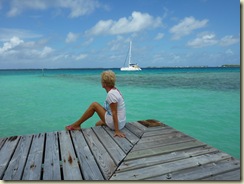
P1000250Photo:  Posing?  Moi?

Marc arrives and we thank him profusely for his help.  We stand and chat for a while, picking his brains about local islands and more specifically, pearl farms and pearls themselves.  As he used to manage a pearl farm and his girlfriend is a pearl grafter, he gives us lots of information.  Apparently nearly all the pearls farms in Manihi have now gone out of business (I thought they all looked abandoned when we arrived) although there are still some in Fakarava (phew) but he says that the best place to get the champagne pearls that I want is in Australia where they specialise in them.  Mike’s wallet might have a reprieve then!

Marc is extremely knowledgeable about diving and gives us all the places to go in Fakarava, but warns us about the sharks there as people keep feeding them when they are in the water.  Apparently three people were bitten yesterday.  Three!  In one day!  There’s no way I am going in the water.  If you need a diver here, Marc’s your man – what he doesn’t know about diving (and pearls) isn’t worth knowing!  He can be contacted on 96 42 17.

P1000251 Photo:  The lovely Marc and I

We say our goodbyes and go back to Jeannius.  My heart is in my mouth when we get the anchor up but all is OK.  We make our way towards the pass out of the lagoon and can see, even from a distance, that the out flowing tide is quite fearsome.

P1000254 Photo:  The sea churns through the pass as the tide runs out

It’s actually quite scary going through the pass but I have the presence of mind to film it.  Apart from a small area just inside the lagoon which is only 20 feet deep, the rest is over 50 feet but the churning of the water is quite incredible and you can feel the pull of the 5 knot current as it drags us out and from side to side, the stern of the boat slewing like a mini slalom.  I am relieved when we get through even though we have loads of clearance below and to either side.

We put the main sail up but have the two reefs in, and the full genoa.  There’s quite a bit of breeze, and not actually in quite the right direction so we will have to change course half way there.  I go for a sleep in the afternoon, but of course, don’t manage to drop off and eventually come up and Mike goes down instead.  I am sitting in the cockpit watching the sun go down when I notice that the wind is steadily dropping, but looking at the instruments, I can see that we have the same wind as before but our speed has slowed dramatically.  I look at the course indicator and realise that Samantha is pre-menstrual and therefore away with the fairies again – she has put herself into standby rather than steering to the wind.  Although I know how to correct this, I had failed to notice what course we were actually steering and run to get Mike.  By the time he comes up the boat has changed direction (the sun now going down on the other side of the boat – bit of a giveaway, that) and Mike has to put the engines on to push the boat back onto the right course.  Bloody Samantha!

The sea is extremely uncomfortable and we are going almost directly into the wind – going to St Martin conditions again.  The waves hit the boat at the most uncomfortable angle and make the most amazingly horrible, load noise, like a series of mini explosions.  It really does sound like she is going to break apart at times.  Yuk.  There are frequent squalls that bring heavy downpours, but as quickly as the salt is washed off the boat (and believe me there’s a lot) the next waves put it all back on again.

Mike goes back to bed for another couple of hours and I stand watch, glaring at the autopilot, although at least I know our course now.  When Mike comes back up we have some supper then he takes the first watch and I go down to sleep.  Sleep?  Fat chance!


Our position is:  15 deg 17 min S, 145 deg 45 min W

Distance so far:  6318 nautical miles

20 April 2010

Day 105: Manihi, Tuamotus – 20/04/10

Well, today’s title should have read ‘Manihi to Fakarava’ but here we still are, stuck in paradise.  Literally!  Stuck!

The day starts innocently enough.  Wake up (obviously … well not  always obvious in my case as according to Mike I am a morning zombie), breakfast (eating the most enormous pamplemousse I have ever seen), get washed and sort of dressed, then start to pull the anchor up.

P1000207Photo:  At over 6” across, this is what I call a pamplemousse!

It pulls up enough to remove the hook and the bridle, and another 20 feet of chain come up easily but then suddenly, and with a huge jerk, the boat pitches forward and down and the chain stops coming up.  I take my foot off the windlass button immediately so as not to burn the motor out, wait for the boat to drift forward a bit (this normally does the trick) then have another go.  Another huge jerk, then nothing.  OK, so the anchor is jammed.  Nothing serious.  It’s happened before.

Mike moves the boat round to a different angle and we try again.  Nothing.  We move the boat to 180 degrees from where we were and have yet another go.  No chance.  Nothing.

Mike decides to get his Hooka gear on and dive down to take a look.  This takes some time to organise but eventually he is ready, and with what looks like a vacuum cleaner hose suctioned to his face, off he goes, leaving me with orders to keep a watch on the pressure gauge.

P1000211 P1000212 Photos:  All kitted out and ready to do battle with the anchor

I watch the gauge, watch for his telltale bubbles and take pictures of the pretty scenery all around.

P1000213 P1000214 Photos:  Pretty above the sea, pretty annoying below

He’s back fairly quickly as the breathing hose won’t quite reach the anchor.  We disconnect it and move the Hooka to the trampoline, giving us a further 40 feet to play with, re-connect it all and down he goes again.

P1000221 Photo:  Back for another go

He comes back up again and asks for the broom handle so that he can give the anchor a good poke (actually I think he just wants to hit something).  It only seems to be dug in deep to sand, although there must be a rock under there somewhere giving it something to hold to.

He manages to get down to the anchor - only just making it though as the Hooka gear is only rated to 14m and we are in 17m of water – poking underneath it with the broom handle to try to loosen it and trying to pull it out by hand but the wind is putting too much pressure on the chain.

He comes up and shouts for me to get one of the 'hurricane lines'.  These things are bloody heavy – 100 feet of rope over one inch in diameter and they are down in the bow lockers.  Dragging one out is flipping hard work for me, but having done so and tying it on to Jeannius, he discovers that it is not long enough and has to come back up for another one, ties them together, goes back down, ties it around a bar at the front of the anchor and then finally climbs back aboard Jeannius.

We take the strain on the line and motor forward ... bang ... the line goes slack and we think we've snapped it, but when we pull it up and can see that the line and the bowline on the end are intact, Mike realises that we’ve pulled the one inch bar off the anchor!

Frustrated and tired, I try to phone the local scuba shop - the phone number doesn’t work - call the big hotel where the scuba shop is located - no answer!

Mike goes back down and ties the line around the shank of the anchor, comes up, gets in the dinghy and tries to pull the anchor forward.  Nothing.  He ties the line to Jeannius, motors forward, and infuriatingly we just go round in circles.  At this point, he gives up.

P1000224 Photo:  Frustrated, Mike and his Hooka come back to the boat

He could have tried putting the stern anchor off the bow to take the strain off the main anchor but there is so much rock/dead coral down there he'd probably just get that one stuck too.  The other thing he could have tried was getting me to take the strain off the anchor by motoring gently forward, but with the air line from the Hooka down, it doesn’t seem like that good an idea.

He calls the hotel again and this time someone answers and gives us the proper number for the scuba shop and we are able to organise for Marc from Blue Nui Dive Centre, to come out tomorrow.  Graham from Eowyn also calls on the Iridium phone and gives us the number for another diver so we should be able to get the anchor up one way or another tomorrow and head off to Fakarava.

By the end of the day we are both aching and tired.  I make an easy but delicious meal (wonderful pasta with chilli and garlic – good comfort food) – and we sit in our cool TV room (the stern cabin!).  Hopefully things will be sorted tomorrow.

19 April 2010

Day 104: Nuku Hiva, Marquesas to Manihi, Tuamotus – 19/04/10

Mike wakes me from a deep sleep and I take a while to come to, sitting dazed on the sofa like some sort of nautical zombie and he goes to bed.  Luckily I don’t get engrossed in a film, and I am staring relatively vacantly towards the navigation instruments when I suddenly see the wind force indicator leap from a force 5 to a force 7.  I leap across to check the instruments more thoroughly.  A squall has crept up behind us and even with the main reefed in as much as it will go and no genoa out, the sudden increase in wind to over 30 knots is giving us a speed of nearly 8 knots.  I have to wake Mike up.  He’s only been down for about 15 minutes but he is flat out.

He comes up, putting on his waterproof as he goes outside, for now the rain is coming down quite hard, and I lie down on the sofa to await instructions.  I try it on a bit – you know, the “well now you’re up I may as well go back to bed” sort of thing – but he’s having none of it.  Apparently I might be needed, so I stay in the salon and await my instructions.  After an hour or so, the squalls have passed, and relative calm is restored and Mike goes back to bed, leaving me with one eye on the PC watching a film, and the other warily glaring at the instruments, daring them to change again.  They don’t.

As the sun comes up I start to see the tiny islands appearing on the horizon – tiny things sprinkled sporadically on the coral reef – the atoll of Manihi.  A couple of hours later we swap place and I fall asleep, to be woken by the pitching and lurching of the boat, announcing that we are into some rough water.  A few minutes later Mike comes in and says he needs my help as we are approaching the channel in the coral reef (the entrance to the lagoon).  This means I have to stand at the front and look out for any nasties in the water that might try to sink us.

We are in water so deep that the depth gauge cannot read it then suddenly, a couple of hundred yards from the start of the channel, it’s just 50 feet.  Unfortunately the sea is too rough for me to see anything, as it ruffles the surface of the waves and screws up the visibility.  Still, the channel is wide and deep enough and we have no problems.

The lagoon is littered with pearl farms (little buildings on stilts, seemingly deserted but probably not so) and areas where the coral heads stick up out of the water.  We skirt around everything, making our way slowly towards the anchorage where the main village is but as it is so rough, we carry on going.  In places, there is just bare coral sticking out of the sea, the only thing separating you from the ocean outside, with no trees or anything to show, from a distance anyway, that you can’t get through, a deathtrap in years gone by.  Now of course, there are nice channel and reef markers that are lit up at night (mostly!). 

P1000172 Photo:  The Pacific Ocean beyond the reef

We end up at the second anchorage, Tetarefa - there is nothing there that we can see except sand, sea and palm trees – no other WARC yachts, in fact, no signs of life anywhere.

P1000183 Photo:  Today’s view

We put the anchor down and Mike immediately tries to get us some internet connection.  He’s successful although the connection is excruciatingly slow.  Once e-mails are checked, he puts a line out and almost immediately catches a fish but we are not sure what it is (possibly a grouper?) so he lets it go.  It splashes its tail rudely as it swims away.  That’s thanks for you!

P1000187 Photo:  The one we let go

After lunch, it’s a sleep (for those who can manage to nod off – not me today) then just an afternoon of lazing around.  Although the wind calms down a little, it’s still too rough for swimming.  We ‘catch’ something bigger in the late afternoon, but it disappears with our lure having bitten through the nylon line.  Maybe I’m glad I didn’t go swimming after all!

The sunset, when it comes, is not through clear skies, but the clouds make it beautiful anyway.

P1000201 P1000205 Photos:  Sunset from the lagoon on Manihi

P1000198 Photo:  A pearl farm silhouetted in the failing light

Tomorrow we will probably head off to Fakarava, further south.


Our position is:  14 deg 27 min S, 146 deg 02 min W

Distance so far:  6256 nautical miles

18 April 2010

Day 103: Nuku Hiva, Marquesas to Manihi, Tuamotus – 18/04/10

We continue to make better headway, with the winds gradually increasing until during the morning we are romping along with an average of 8 knots.  This is the sort of sailing that we have been wanting for the last few days and now that we are nearly there, the wind decides to play ball.  Unfortunately, they play ball so enthusiastically that in the afternoon we have to reef the main and the genoa in as if we continue at this rather nice speed, we will arrive in darkness. 

The atolls are not the place to arrive in the dark.  Surrounded by magnificent coral reefs just waiting for you to impale your boat on, a daylight arrival is imperative.  Even inside the lagoons, reefs and rocks abound, most of them marked, some of them not, and of course there are the fishing markers to avoid too.

By early evening the winds are still strong, and even reefed in, it is obvious we are going to arrive too early, so Mike takes in the whole of the genoa, and we manage to slow the boat down to just over 5 knots.  Typical.  When we don’t need the wind, we get it!


Our position is:  13 deg 57 S, 145 deg 39 min W

Distance so far:  6209 nautical miles

17 April 2010

Day 102: Nuku Hiva, Marquesas to Manihi, Tuamotus – 17/04/10

We catch a couple of showers from passing squalls but that’s about it on my second watch.  We limp pathetically slowly across the Pacific, doing as little as two knots at times.  It seems that Mike’s plan to avoid buying me a necklace in the Tuamotus is coming to fruition.  However I am not too worried as I know there’s a really expensive pearl shop in Tahiti and expect this fact to eventually spur him on to putting the engine on when the realization that there is no escape from the inevitable hits him.  I go down to bed as soon as Mike comes up but as usual, as I am supposed to be sleeping, I can’t.  Eventually, I give in and get up again.

There is nothing to look at apart from the squalls that continually appear on the horizon.  The ones in the distance seem to take all our wind.  This is what Mike says anyway but he could be telling me a lot of dodgy BS and if it’s anything to do with sailing, weather at sea or astronomy I automatically believe him.  To this effect, I really must do some reading!

I notice that the green algae is already starting to make its appearance again just above the antifouling and along the rubbing strip on the transoms.  Great.  More scrubbing.

In the mid afternoon the wind starts to pick up until at last we have a bit of good sailing (the pearl necklace gods are obviously favouring me here).  The wind gets up to 18 to 20 knots and we romp along doing over 8 knots.  Then a large squall appears on the radar and we have to reef right in as we have no idea how strong the winds will be within it.  We get rained on really heavily but the wind doesn’t actually get above 25 knots in the end and Mike puts all the sails back out.  I manage to fall asleep after this, lying reading on the sofa and wake up feeling quite refreshed.

When Mike goes for a shower he emerges a few minutes clutching something in his hand wrapped in toilet paper – a crab!  About one and a half inches across and black, he looks like one of the crabs that we found living in the long, green Galapagos beard on Jeannius’ hulls.  Now homeless, he had probably climbed up the hull, scuttled across the top and fallen into the bathroom via the open hatch.  As Mike opens his hand to show me, the crab jumps out and scuttles off, nearly getting himself crushed as Mike tries to pick him up again.  I’m standing there screaming – it’s like having a spider on the loose at home, but Mike manages to catch him and throw him overboard again.

The winds continue to be stronger during the evening and we take in the genoa just in case.  Throughout the night we average about 5 knots.  I am beginning to see some pearls on the horizon …… !


Our position is:  12 deg 16 min S, 143 deg 55 min W

Distance so far:  6068 nautical miles

16 April 2010

Day 101: Nuku Hiva, Marquesas to Manihi, Tuamotus – 16/04/10

Mike wakes me at midnight for my watch.  We are still sailing along very slowly and still with no engine on but at least it makes for an uneventful watch.  For the first half an hour I lie on one of the cockpit cushions and watch the stars as they and the Milky Way are so clear tonight.  For the rest of the time I watch TV.

During Mike’s second watch we get a huge downpour from one of the passing squalls and we even get 30 knots of wind out of it although I sleep right through it.

P1000160 Photo:  Squall on the horizon

We hear Chessie and Tucanon on the SSB.  Both are now heading for islands in the Tuamotus further south than us and both have the same zero winds as us but they are both motoring, while we continue to sail pathetically slowly.

P1000161 Photo:  The never-ending job of tidying ropes!

The day passes with nothing to watch except the flapping sails.  The upside is that you can’t possibly get sea sick when the conditions are like this!  There are constant squalls on the horizon which show up on the radar as big yellow blobs, but we manage to sail right through the middle of them.  I do the first watch, waking Mike at midnight to relieve me.


Our position is:  10 deg 53 min S, 142 deg 14 min W

Distance so far:  5940 nautical miles